
Business Health Insurance for UK Companies
Retaining top-tier talent in a competitive UK labour market demands more than salary alone: a comprehensive company health insurance scheme signals genuine investment in your workforce. Structuring cover through a corporate group policy creates significant Corporation Tax efficiencies whilst dramatically reducing workplace absenteeism through immediate private clinical pathway access. An insurance specialist working for an FCA-authorised firm can help you explore cover options and design a scheme suited to your business.
Prefer watching? This comprehensive guide breaks down how business health insurance works for teams and companies in around 10 minutes, covering how employers can review Group Private Medical Insurance (PMI) scheme options to reduce workplace absenteeism, protect staff, and attract top-tier industry talent.
An Investment In Your People
Whether you're employing your first member of staff or managing a growing business, private health insurance is one of the most valuable benefits you can offer.
It's not simply about providing faster access to private healthcare. It's about protecting your business from the financial impact of long-term sickness, supporting employee wellbeing and helping your team return to work sooner.
For company directors, it's also about protecting one of the business's most valuable assets, you.
This guide explains everything you need to know about business health insurance in the UK, including how group schemes work, Medical History Disregarded underwriting, premiums, tax considerations, group leavers and what to look for when choosing the right policy.

What Is Business Health Insurance?
Business health insurance, sometimes called corporate or group private medical insurance, allows employers to provide private healthcare for their employees.
Policies can be arranged for businesses of almost any size, from small companies with just a few employees through to national organisations with hundreds or even thousands of staff. In fact, cover is highly adaptable and suits everyone from self-employed professionals to contractors transitioning into limited companies.
Unlike individual policies, business health insurance is designed around the needs of the company and often becomes more cost-effective as employee numbers increase.
Many employers also choose to include partners and dependent children as part of their employee benefits package, depending on how generous they wish the scheme to be.
How Business Health Insurance Works
Instead of each employee arranging their own policy, the business takes out a group policy covering eligible members of staff. Employees receive access to private healthcare while the company manages a single scheme.
Flexible Cover
Choose cover levels & hospital lists tailored to your workforce and budget.
Single Scheme
Managed as a single group scheme, simplifying administration for the business.
Group Premiums
Premiums calculated differently to individual policies, often spreading risk more effectively.
Family Extension
Options to extend cover to partners and children of your employees.
Why Business Health Insurance Makes Sense
Providing private health insurance isn't simply an employee benefit. It's a business investment.
- Faster Return to Work
When employees receive quicker access to diagnosis and eligible treatment, avoiding lengthy NHS access delays, they often return to work sooner, reducing disruption.
- Protect Key People
If the person responsible for leading the business becomes unavailable for months, the financial impact can be significant.
- Flexibility & Control
Private healthcare helps put control back into the hands of employers and employees by allowing appointments around work commitments.

How Premiums Are Calculated
Business health insurance is rated differently from individual or family policies.
One of the biggest advantages of group schemes is that premiums often become more competitive as employee numbers increase.
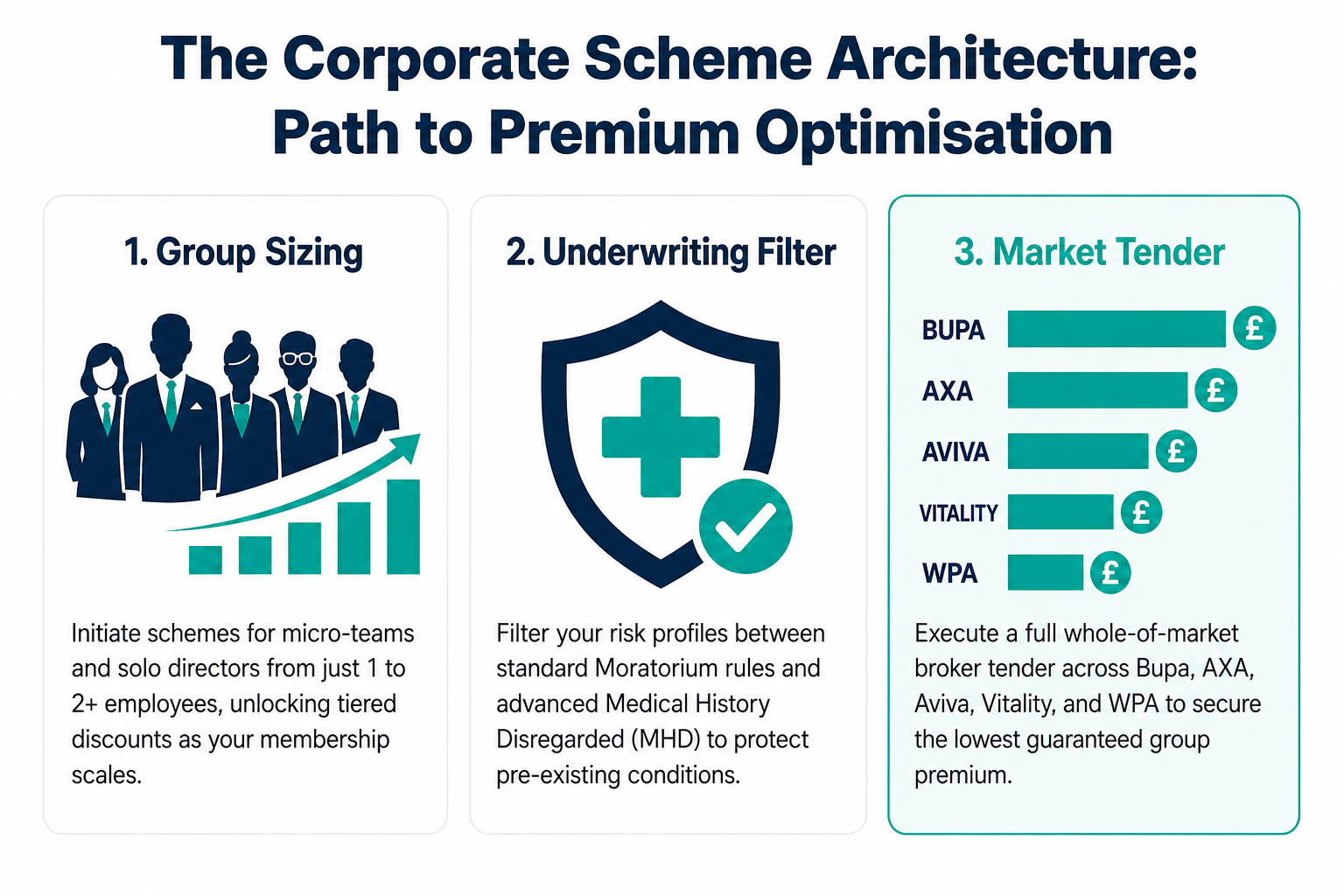
Many insurers, including AXA Health, reduce their rates at specific membership bandings, such as three members, six members and nine members, with further reductions as schemes continue to grow.
Larger businesses spread risk across a greater number of employees, making group schemes more cost-effective than smaller groups.
Tax Considerations for Business Health Insurance
Employer-paid PMI premiums are generally treated as an allowable business expense for Corporation Tax purposes, reducing your company's overall tax burden.
For employees, this cover is classified as a Benefit in Kind (BIK) and must currently be reported on P11D forms. The employer is responsible for paying Class 1A National Insurance contributions on the benefit value.
Important Change: From April 2026, mandatory payrolling of benefits in kind will replace P11D forms for most benefits. Businesses should begin preparing for this administrative change now.
Because individual corporate structures vary significantly, we always recommend consulting your accountant or tax adviser to understand how these rules apply to your circumstances. You can also explore more in our insurance guides and our insurance explained overview.
Comparing UK Business Health Insurers
An insurance specialist working for an FCA-authorised firm can compare UK business health insurers to help find suitable group rates for your company.
| Provider | Min Scheme Size | Key Strengths |
|---|---|---|
| Aviva | 1+ Employee | Micro-team accessibility from day one; exceptional modular pricing; native inclusion of digital workplace wellness tools. |
| AXA Health | 1+ Employee | Open to solo directors; highly structured volume discounts scaling aggressively at 3, 6, and 9 members; versatile outpatient modules. |
| Vitality | 1+ Employee | Premium business structures for single-member firms; rewards ecosystem that lowers renewal rates via active wellness tracking. |
| Bupa | 2+ Employees | Highly reliable small group setups; premium tier access to London networks; rapid mental health clinical paths. |
| WPA | 2+ Employees | Dedicated small business solutions; not-for-profit structure ensuring long-term premium stability; flexible cash options. |
Medical History Disregarded (MHD)
Medical History Disregarded underwriting is one of the biggest advantages of business health insurance.
Unlike individual policies, where medical history is assessed person by person, qualifying business schemes may be able to offer cover without individually assessing employees' previous medical conditions.
The availability of MHD depends on several factors, including the insurer and the number of eligible employees joining the scheme.
Because each insurer has different eligibility requirements, it's important to obtain independent advice before deciding which provider is most suitable.
For many businesses, MHD is one of the most valuable benefits available through a company health insurance scheme.
How Claims Affect Business Health Insurance
This is one area that's often misunderstood.
On a personal or family policy, each individual usually has their own No Claims Discount. If one family member makes a claim, it generally only affects that person's future premium.
Business health insurance works differently.
"Group schemes are assessed on the overall performance of the policy."
Rather than looking at one individual's claims history, insurers review how the scheme has performed as a whole.
Larger businesses often benefit because claims are spread across many employees. A small business with only three members may notice the impact of claims more than a company with fifty or one hundred employees.
It's also worth remembering that No Claims Discount protection, available with some individual insurers such as AXA Health and Aviva, isn't normally available on business health insurance policies.
What Happens When Someone Leaves the Company?
This is one of the biggest issues employers encounter.
Many employees enjoy years of private health insurance through their employer without ever thinking about what happens when they leave.
When employment ends, employees usually become what is known as a Group Leaver.
The existing insurer may offer the opportunity to continue cover while maintaining previous underwriting. However, these quotations are often significantly higher than many people expect.
"One recent client in their thirties received a continuation quotation of more than £750 per month, despite a brand-new individual policy costing a fraction of that amount."
The reason is simple. The existing insurer is usually the only company able to continue covering the employee's medical history in its entirety without reassessing previous conditions.
This is why receiving advice from an insurance specialist working for an FCA-authorised firm before accepting a Group Leaver quotation can be invaluable.
Why Independent Advice Matters
Business health insurance is about much more than comparing premiums.
An insurance specialist working for an FCA-authorised firm understands how each insurer structures cover, how underwriting differs, how Medical History Disregarded works and how group schemes perform over time.
At renewal, that specialist can review the market, assess your claims performance and recommend the most suitable solution based on your employees' medical circumstances, your budget and your long-term objectives.
The aim isn't simply to reduce premiums. It's to protect as much medical history as possible whilst maintaining or improving the quality of cover.
For busy business owners and directors, having that process managed by an experienced specialist can save significant time whilst ensuring informed decisions are made each year.
Is Business Health Insurance Worth It?
For many employers, the answer is yes.
"Healthy employees are generally more productive, experience less disruption and appreciate having access to high-quality healthcare when they need it."
For business owners and company directors, private health insurance also provides reassurance that if something unexpected happens, diagnosis and treatment can often be arranged much more quickly than relying solely the NHS.
Ultimately, it's an investment in both your people and your business. It allows you to protect your workforce, extend family cover to their loved ones, and improve your overall benefits package. If you're ready to see what's available, you can compare private health insurance options today.
Trusted by UK Business Owners
Real customer experiences shared with elev8.
Frequently Asked Questions About Business Health Insurance
Speak With an Insurance Specialist
Every business is different, which means there isn't a one-size-fits-all solution.
Whether you're looking to introduce health insurance for the first time, review an existing scheme or understand your options before renewal, independent advice can make a significant difference.
Elev8 Health Solutions can connect employers, company directors and business owners with an insurance specialist working for an FCA-authorised firm to explore their options and understand cover suited to their people.
Make an enquiry today and start exploring the right solution for your business.
Any regulated insurance advice or policy arrangement is provided by the FCA-authorised firm responsible for the enquiry.