
UK Health Insurance Underwriting Explained
The No-Nonsense Guide to Moratorium vs Full Medical Underwriting
Understanding how private medical underwriting works is the single most important step to protecting your cash flow and ensuring your future claims are paid without delay. Whether you are setting up a company director scheme, a group startup policy, or an individual self-employed plan, this guide breaks down exactly how UK insurers look at your medical history.
What is Underwriting?
In private medical insurance, underwriting is the process insurers use to evaluate your medical history. It fundamentally dictates what you are covered for and, crucially, what you are not covered for regarding your past health.
Because health insurance is primarily designed to cover acute, unforeseen medical conditions that arise after your policy begins, pre-existing conditions are usually excluded. How and when those exclusions are applied is determined by your chosen underwriting method.
Understanding these rules ensures there are no surprises when you need to make a claim in the future.

What is Moratorium Underwriting?
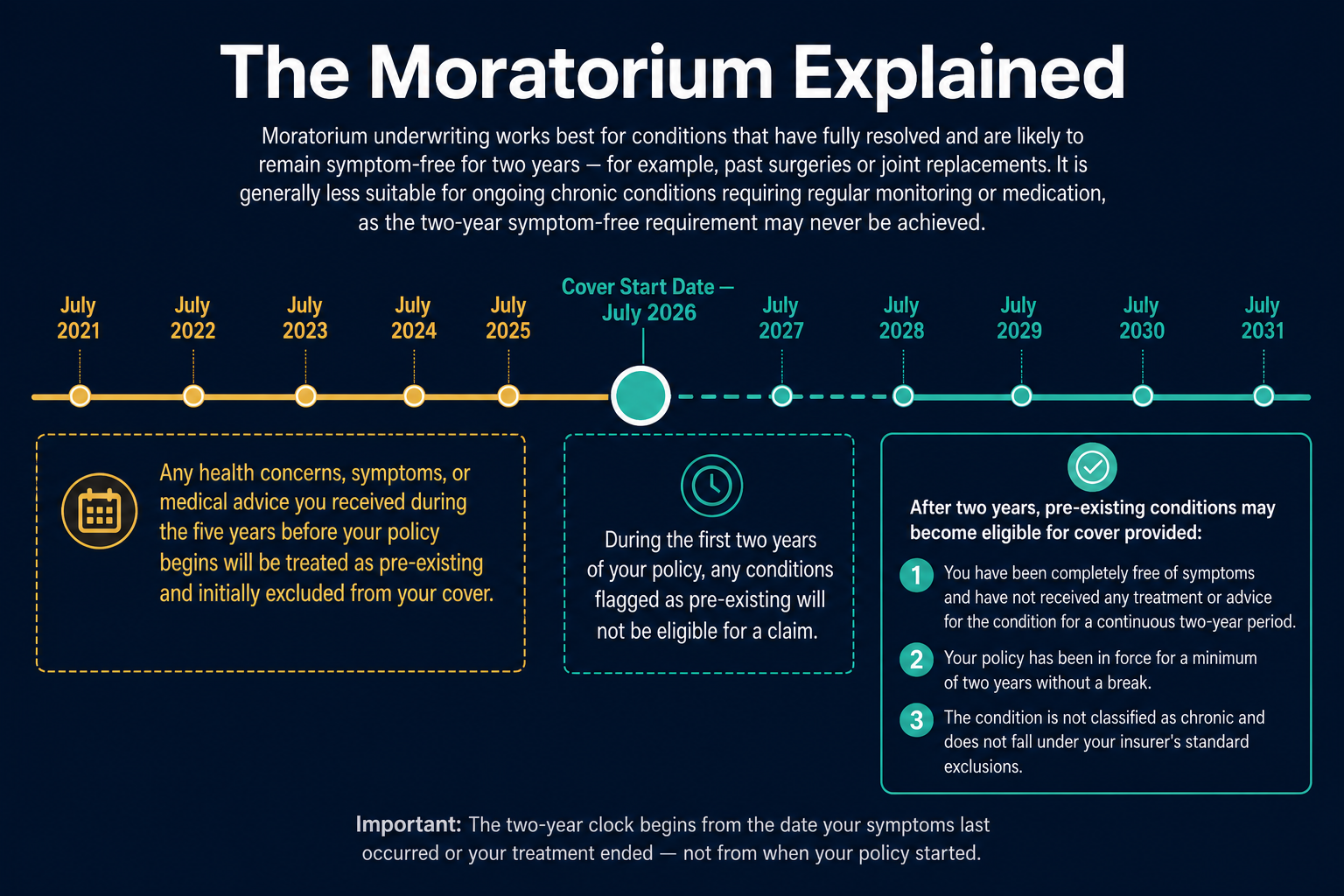
A Moratorium is the most popular way to set up health insurance because it doesn't require you to fill out a lengthy medical questionnaire or disclose your entire doctor history on day one. Instead, the insurer applies a simple, automated timeline rule to look back at your past five years of health concerns.
Watch: Moratorium vs Full Medical Underwriting Explained
In this video, Aaron breaks down the key differences between moratorium and full medical underwriting to help you understand which approach may suit your situation.
Prefer watching? This comprehensive guide breaks down the core differences between Moratorium and Full Medical Underwriting rules in under 3 minutes. Our experienced UK health insurance specialist explains how to safely navigate pre-existing condition exclusions, protect your business continuity, and choose the right framework for your household or company team.
The Application Stage
Setting up a Mori policy is fast because your medical history is not assessed upfront.
- No lengthy medical questionnaires
- No GP reports required at application stage
- No medical paperwork required
- Usually only simple eligibility, lifestyle and tobacco use questions
- Quick and easy to arrange over the phone
The Claim Stage
With a Moratorium, underwriting is assessed at the point of claim rather than when the policy starts. When you submit a claim, insurers may contact your GP or specialist to review your:
- Symptoms
- Treatment history
- Medication history
- Medical advice received
- Investigations and tests
The insurer will then determine whether the condition is eligible for cover under the Moratorium rules.
Not All Moratoriums Are Equal
It is vital to understand that Moratorium underwriting rules differ between insurers. The key difference lies in how they handle conditions related to your past health issues.
Related Moratoriums
Some insurers apply a "Related Moratorium." This means they may exclude future conditions that are considered medically related to a pre-existing condition, even if the new condition wasn't directly diagnosed before.
Specified Moratoriums
Other insurers use a "Specified Moratorium." These providers specify exactly which underlying conditions remain excluded, generally providing greater clarity, certainty, and potentially broader coverage for subsequent illnesses.
Example: High Blood Pressure (Hypertension)
To illustrate how underwriting can differ drastically between insurers, let's look at how hypertension is assessed across two different providers.
The Exeter Approach
- In many cases The Exeter takes a targeted approach where the exclusion applies to the hypertension itself and do not relate any cardiovascular issues for having hypertension.
- Where there have been no symptoms, investigations, treatment changes or related issues during the relevant qualifying period, future conditions may be assessed separately rather than automatically being treated as related.
AXA Health Approach
AXA Health uses a specified approach. AXA may specify the following exclusions: Ischaemic Heart Disease, Stroke, Hypertensive Renal Failure.
Where the following criteria are met:
- BMI between 18 and 32
- Age over 40
- Blood pressure controlled by medication for at least 2 years
- No diagnosis of diabetes / Not currently being investigated for diabetes
AXA may effectively limit the exclusion to the hypertension itself and underlying cause. They would then not apply any further exclusions for any blood pressure related conditions as well as the 3 that are specified.
Disclaimer: Underwriting decisions are always subject to insurer rules and individual circumstances. This example is for illustrative purposes.

Full Medical Underwriting (FMU)
Unlike a Moratorium, Full Medical Underwriting assesses your medical history before the policy starts.
Clients complete a detailed medical questionnaire covering their entire health history, including:
- Medical conditions and diagnoses
- Current and past medication
- Operations and surgeries
- Medical investigations and scans
- General treatment history
Once the insurer reviews this information, they will confirm in writing exactly which pre-existing conditions are excluded from the cover. This provides absolute clarity from day one.
Comparing Your Options
A quick summary of the structural differences between the two main underwriting types.
Moratorium (Mori)
Quick Setup
Policies can be activated quickly without needing doctor reports upfront.
Minimal Questions
Only basic lifestyle and eligibility questions are required at the outset.
Assessed at Claim Stage
Underwriting happens when you make a claim. The insurer checks your medical records then to determine if the condition is pre-existing.
Full Medical Underwriting (FMU)
Detailed Questionnaire
Requires full disclosure of your medical history upon application.
Exclusions Confirmed at Outset
You receive written confirmation of exactly what is and isn't covered from day one.
Greater Certainty Before Claiming
Because everything is established upfront, claims are processed faster with no unexpected rejections regarding past health.
Why Underwriting Matters
Two health insurance policies can have very similar premiums but vastly different underwriting outcomes based on your personal health history.
Choosing private medical insurance should involve understanding both the policy benefits and the specific underwriting terms. An incorrectly chosen underwriting method can leave you exposed when you need treatment the most.
How Elev8 Health Solutions Can Help
With over 10 years' experience in private health insurance, Elev8 provides clear information to help you understand:
- Moratorium underwriting & Full Medical Underwriting
- Pre-existing condition clauses
- Related conditions vs Specified exclusions
- Policy options tailored to your needs
Get in touch today, and we can connect you with an insurance specialist working for an FCA-authorised firm to discuss which underwriting approach may be most suitable for your circumstances.
Speak With an Insurance SpecialistFrequently Asked Questions
Understand Your Underwriting Options
Don't let complex underwriting terms leave you unsure of your cover. Speak with an insurance specialist working for an FCA-authorised firm to understand your options.
Speak With an Insurance Specialist